Balancer2026-09-15 16:13:58Balancer weighs an orderly shutdown as governance proposal puts DAO treasury distribution on the tableBalancer is discussing a proposal that could wind down the long-running DeFi liquidity protocol and return remaining DAO treasury assets to BAL holders. The proposal, put forward by Balancer Labs CEO and Treasury Council member Marcus Hardt, is now under forum discussion, with a Snapshot vote expected between Sept. 25 and Sept. 29. Balancer said no shutdown decision has been made at this stage, and that liquidity pools and withdrawals remain fully operational unless governance approves the plan. Hardt said the protocol’s April restructuring — which included cost cuts, ending BAL emissions, simplifying the token model and redirecting protocol revenue to the DAO — failed to restore sustainable revenue growth. According to the proposal, Balancer’s monthly spending is about $150,000, while protocol revenue in August was roughly $30,000, down from about $97,000 in June. Treasury asset management adds about $25,000 a month, and the managed DAO treasury is valued at no less than $9 million at current token prices. If approved, Balancer would move through a phased shutdown beginning in late 2026, eventually leaving only withdrawal infrastructure and documentation. Treasury assets would be distributed over multiple rounds, and BAL holders would need to burn their tokens to claim a proportional share of the treasury’s actual token holdings.840
Arbitrum2026-09-11 04:11:29Arbitrum says revenue so far in Q3 is up about 140% from Q2Arbitrum Foundation investment strategy lead Brendan Ma said in a post on X that Arbitrum’s revenue so far in the third quarter has risen about 140% compared with total revenue in the second quarter. He said the increase was mainly driven by Robinhood Chain licensing fees and treasury yield. Ma also disclosed that DAO treasury revenue reached $2.59 million over six days since September began, implying annualized revenue of more than $150 million. The figures were shared directly by Ma and were cited by Odaily in a 7x24 news update. No additional details were provided in the post excerpt about the specific breakdown between licensing income and treasury-related gains.770
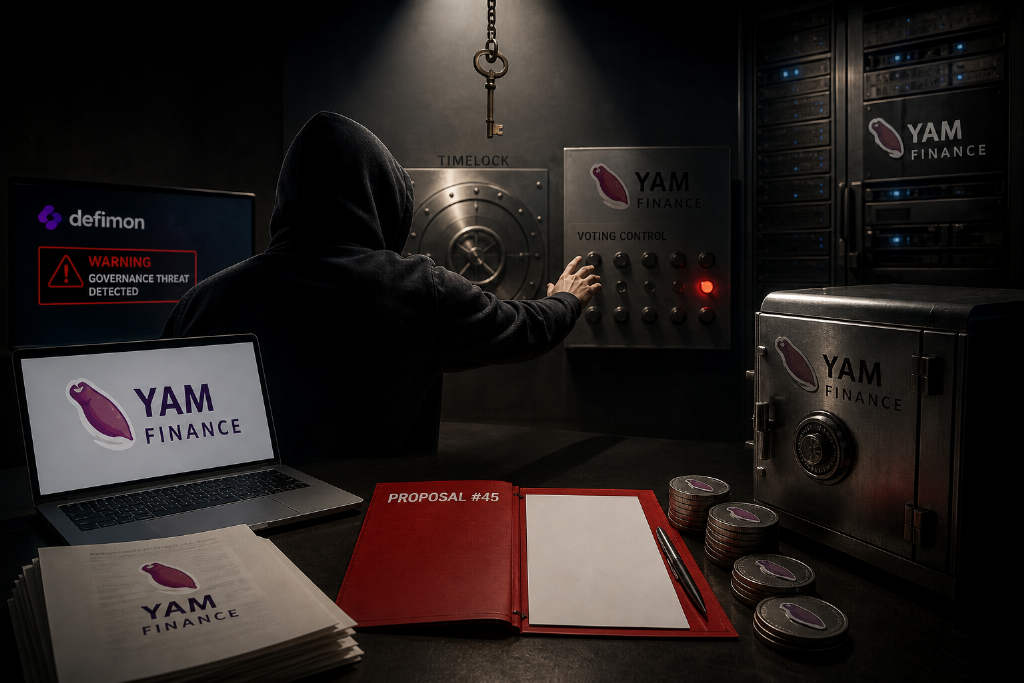
YAM Finance2026-09-02 05:48:03YAM Finance hit by governance takeover attempt targeting Timelock controlYAM Finance is facing a governance takeover attempt, according to monitoring by Defimon. The attacker self-delegated about 504,000 YAM, equal to roughly 3.3% of total supply and slightly above the required proposal threshold, then submitted proposal No. 45 to YamGovernorAlpha. The proposal contains no description and only calls the YAM Timelock contract’s setPendingAdmin function, assigning the role to the attacker’s address. If the proposal passes and is executed, the attacker would become pendingAdmin and could later call acceptAdmin to take full control of the Timelock. That would give the attacker administrative control over all YAM protocol contracts and the DAO treasury. Defimon Alerts said the amount at risk is about $337,000. Because the YAM protocol is currently dormant, YAM holders were urged to vote against the proposal before block height 25897343, which was estimated to be about 34 hours away.810
governance at2026-09-02 05:48:00YAM governance attack: Defimon urges holders to vote against proposalA malicious governance proposal has been detected in the YAM Finance voting system, and security firm Defimon is treating it as an attempted takeover of the protocol. The attacker self-delegated around 504,000 YAM tokens, roughly 3.3% of total supply and just above the governance voting threshold, then submitted proposal #45 to YamGovernorAlpha. The proposal has an empty body, encoded as 0x, and contains one operation: a call to setPendingAdmin on the YAM Timelock contract with the attacker's address as the target. Defimon warns that if the vote passes and the proposal executes, the attacker becomes pendingAdmin and can later call acceptAdmin to take full control of Timelock. That would give the attacker management authority over all YAM protocol contracts and the DAO treasury. The value exposed in this scenario is about $337,000. YAM is currently dormant, but the voting window remains live. Defimon Alerts is therefore urging YAM holders to vote no before block 25,897,343, around 34 hours from the alert.800
Lido DAO2026-08-14 12:14:10Lido DAO outlines NEST model tying protocol revenue to LDO buybacksLido DAO has published an overview of NEST, short for Network Economic Support Tokenomics, a mechanism designed to connect protocol revenue with the value of the LDO token through onchain automation. Under the framework, when revenue from Lido’s staking business rises above a preset benchmark, part of the excess income will be swapped into LDO via CoW Swap, creating a recurring buyback flow. The stated goal is to give LDO holders a more direct way to share in the protocol’s growth. According to the initial parameters released by Lido DAO, the NEST revenue benchmark is set at an annualized $40 million, or about $109,000 per day. Of revenue above that threshold, 50% will be allocated to LDO buybacks. The mechanism also includes a daily buyback cap of $50,000 and a rolling 365-day cap of $10 million. Buybacks are set to run daily through a permissionless onchain process. At launch, NEST will begin in Treasury-only mode, with purchased LDO sent directly to the DAO treasury. Lido DAO said the system could later switch, through an onchain vote and if market conditions are suitable, to an LP mode in which half the funds would buy LDO and the other half would be converted into wstETH to provide liquidity on Curve.1430
DAO treasury2026-08-10 10:08:18GSR says nearly 70% of DAO treasuries still sit in native tokens, leaving protocols exposed in downturnsGSR Global Head of Markets Spencer Hallarn argues that DAO treasuries remain structurally vulnerable because more than 70% of treasury assets are still held in native tokens. In his view, that concentration creates a three-part hit when markets turn: treasury values fall, protocol revenue slows, and on-chain activity weakens at the same time. He also says many teams wait too long to hedge, only seeking downside protection after prices have already dropped and implied volatility has pushed costs higher. Hallarn points to collar structures as one of the most common treasury hedging tools used by GSR, describing them as a way to set a floor while keeping exposure within a chosen range and avoiding an outright sale of tokens. He argues that treasury construction matters more than market timing, especially for teams trying to preserve operating runway. His broader recommendation is to separate operating reserves from long-term crypto holdings, hold cash or stable assets for expenses, and apply hedging where needed so a protocol can keep funding its roadmap through a prolonged downturn.1860
GSR2026-08-08 12:41:41GSR says DAO treasuries remain heavily concentrated in native tokens, leaving projects exposed in downturnsCrypto market maker GSR said in a treasury management analysis published on Aug. 8 that the sector still has a basic structural weakness: close to 70% of DAO treasury assets are held in native tokens, while allocations to stable assets and diversified reserves remain limited. That setup leaves projects exposed to three pressures at once in a bear market — token prices fall, protocol activity slows, and fee revenue shrinks — even as operating costs stay denominated in U.S. dollars. GSR said that dynamic can force teams to sell more tokens at lower prices to meet fixed expenses, adding pressure to token prices and draining treasury runway faster. The firm also argued that many teams seek protection at the worst possible time, avoiding option premiums in bull markets and then rushing to hedge after a selloff, when implied volatility and protection costs are already elevated. As a practical tool, GSR pointed to collar strategies, which can help projects establish downside protection without selling tokens. Still, it said projects that endure through multiple cycles tend to separate operating reserves, long-term holdings, and strategic positions rather than rely on a single all-token treasury structure.1780